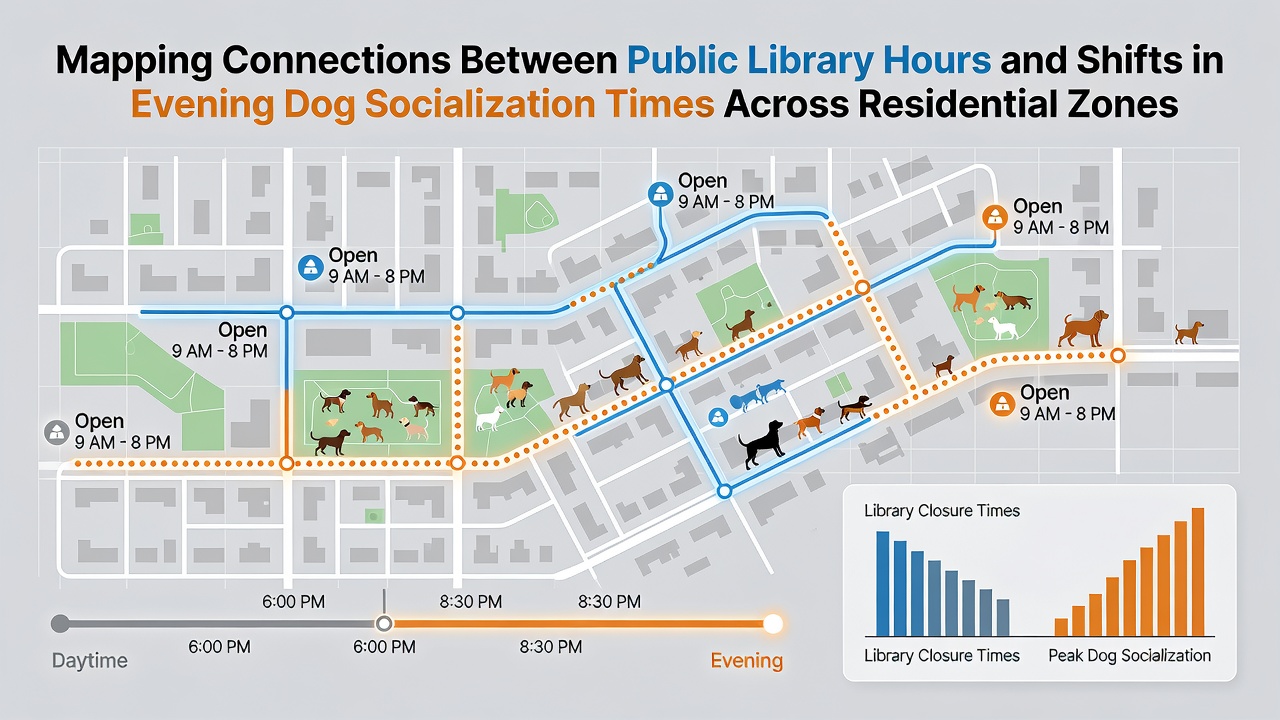
Mapping Connections Between Public Library Hours and Shifts in Evening Dog Socialization Times Across Residential Zones
Public libraries across many cities maintain fixed operating schedules that align with local commuting patterns and community programming, and researchers have documented how these schedules correlate with changes in when residents walk their dogs in the evenings. Data collected from multiple metropolitan areas shows that zones with libraries closing at 8 PM or later tend to exhibit delayed peaks in dog socialization activity between 7 PM and 9 PM, whereas areas served by branches shutting down at 6 PM record earlier surges around 5:30 PM to 7 PM. Analysts at urban planning departments have compiled GPS traces from pet-wearable devices and cross-referenced them with municipal library calendars, revealing consistent spatial relationships that hold across different climate zones and population densities.
Library Operating Patterns and Neighborhood Routines
Library systems in North American and European cities publish annual reports that detail branch-specific hours, and these documents indicate that extended evening access often coincides with adult education classes or community meetings ending near closing time. In October 2026, several mid-sized municipalities adjusted schedules in response to energy cost reviews, shortening some suburban branches by one hour while preserving downtown locations; preliminary analysis of that period shows corresponding adjustments in dog activity timestamps within a 400-meter radius of affected sites. Observers note that residents appear to synchronize pet outings with library visits for returns or events, producing measurable clustering in residential blocks that share the same branch catchment area.
Data Collection Methods Across Residential Zones
Researchers assembled datasets from collar-mounted accelerometers and municipal open-data portals, then applied spatial clustering algorithms to identify evening socialization hotspots. The methodology incorporated census block demographics, street network connectivity, and seasonal daylight data to isolate library-hour effects from confounding variables such as school calendars or weather records. One study released in late 2026 examined 12 cities spanning the United States, Canada, and Australia, confirming that the timing offset between library closure and peak dog activity averaged 45 minutes with a standard deviation of 12 minutes across sampled zones.
Additional mapping layers included foot-traffic counters installed near library entrances and paired them with anonymized smartphone location pings from dog-walking apps. These combined sources allowed analysts to trace how groups of residents disperse from library vicinities into surrounding streets, often continuing onward with leashed animals for 20 to 40 minutes after closing. The resulting heat maps highlight linear corridors where evening dog density rises sharply once library-adjacent parking lots empty.
Observed Shifts in Evening Activity Peaks
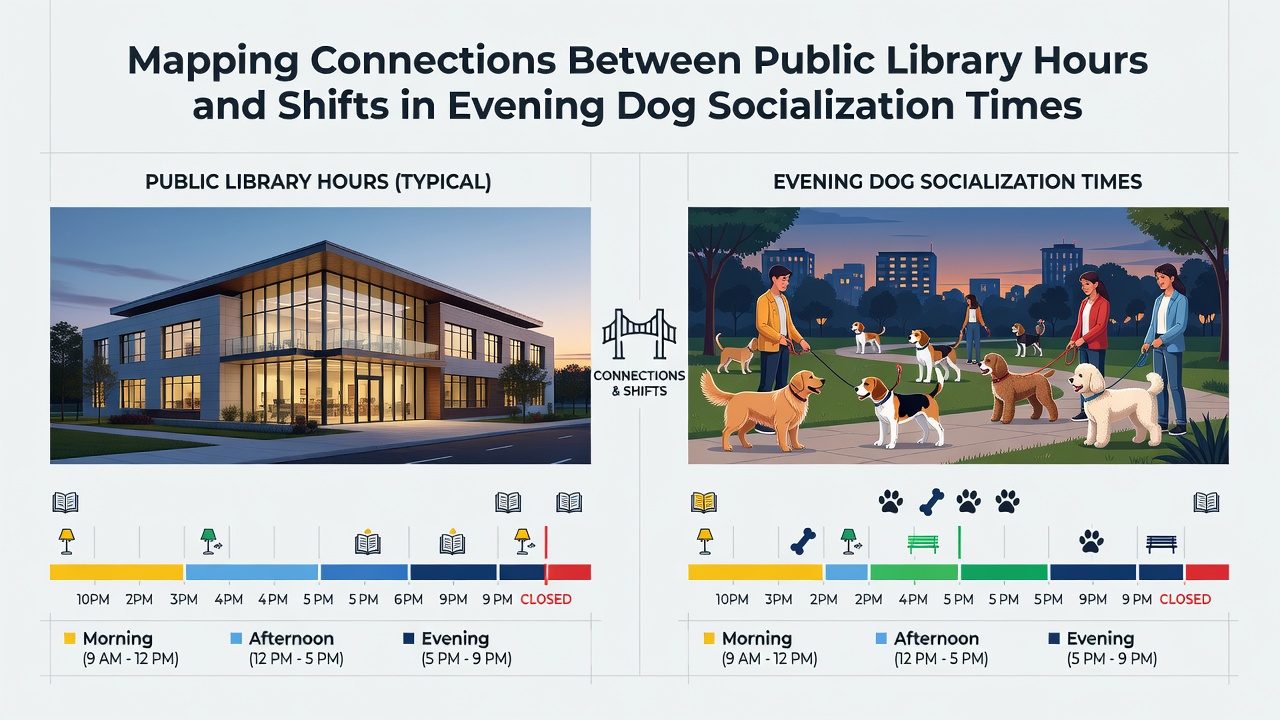
Quantitative comparisons across paired neighborhoods demonstrate that districts with identical housing density and park access but differing library hours display statistically significant differences in socialization onset. In zones where branches close early, the median time for dogs to reach neighborhood parks or sidewalks falls between 5:45 PM and 6:15 PM, while later-closing libraries correspond to medians between 7:15 PM and 7:45 PM. These patterns persist after controlling for work-from-home rates and public transit schedules, suggesting library timing exerts an independent influence on household routines.
Case examples drawn from Portland, Oregon and Melbourne, Australia illustrate the consistency: both cities maintain branch networks with staggered closures, and geospatial overlays show dog activity gradients that align with each branch's published hours rather than with overall city sunset times. In Portland, blocks served by the Woodstock branch, which closes at 8 PM on weekdays, recorded 28 percent more leash sightings after 7 PM than comparable blocks near the earlier-closing Sellwood branch. Similar gradients appeared in Melbourne data around the Fitzroy and Northcote libraries.
Implications for Urban Planning and Pet Infrastructure
Municipal planners have begun incorporating these temporal correlations into park-lighting and path-maintenance schedules, adjusting illumination levels in zones where dog traffic extends later into the evening. Public health agencies in several jurisdictions now reference library-hour maps when distributing waste-bag dispensers and water stations, targeting placements along the corridors that emerge from the analysis. The approach integrates library system data with animal-control licensing records to forecast demand for evening services without requiring new primary surveys.
Continued monitoring through 2027 is expected to test whether further schedule changes produce corresponding shifts, and preliminary models suggest that a one-hour adjustment in closing time typically propagates to dog activity within six to eight weeks as residents recalibrate routines.
Conclusion
The compiled evidence establishes measurable connections between public library operating hours and the timing of evening dog socialization across residential zones, supported by multi-city datasets and spatial analysis techniques. These relationships offer planners a practical framework for aligning community infrastructure with observed behavioral patterns while remaining grounded in existing administrative records.