
How Acoustic Signatures Reveal Shifts in Local Pet Populations During Urban Development Phases
Urban development transforms neighborhoods through new construction, road expansions, and infrastructure upgrades, and researchers track resulting changes in local pet populations by analyzing acoustic signatures from dogs, cats, and other companion animals. Sound recordings capture distinctive barks, meows, and other vocalizations that indicate presence, density, and behavioral shifts without relying on visual surveys or direct counts.
Bioacoustic monitoring programs deploy arrays of microphones across residential and commercial zones undergoing redevelopment, then process the audio through machine learning algorithms trained to isolate pet-specific frequencies from background traffic, machinery, and human activity. Data collected over multiple phases shows how construction timelines correlate with alterations in vocalization patterns, such as increased nocturnal barking in areas where daytime noise displaces daytime activity.
Methods for Capturing Pet Acoustic Data
Teams place calibrated recorders at fixed intervals along development corridors, sampling continuously for weeks before, during, and after major building projects. Software filters separate species-specific calls, with dog barks typically ranging between 200 and 2000 hertz and cat vocalizations clustering in higher bands. Validation occurs through cross-referencing with municipal pet registration records and occasional camera traps to confirm accuracy rates above 85 percent in controlled tests.
Studies conducted in rapidly expanding cities demonstrate that acoustic density metrics drop sharply within 300 meters of active excavation sites, while they rise in adjacent quieter blocks where displaced animals appear to relocate. These patterns emerge consistently across multiple seasons, though winter recordings reveal slower recovery times due to reduced outdoor activity overall.
Observed Population Responses to Construction Phases
During initial site preparation, when heavy equipment operates, acoustic data indicates a 30 to 45 percent reduction in daytime pet vocalizations in immediate vicinities, according to findings published by the Australian Urban Ecology Institute. Evening and overnight signatures often increase as animals adjust schedules to avoid peak disturbance. Later phases involving finishing work and landscaping see partial rebounds, yet total counts rarely return to pre-development baselines within the first 18 months.
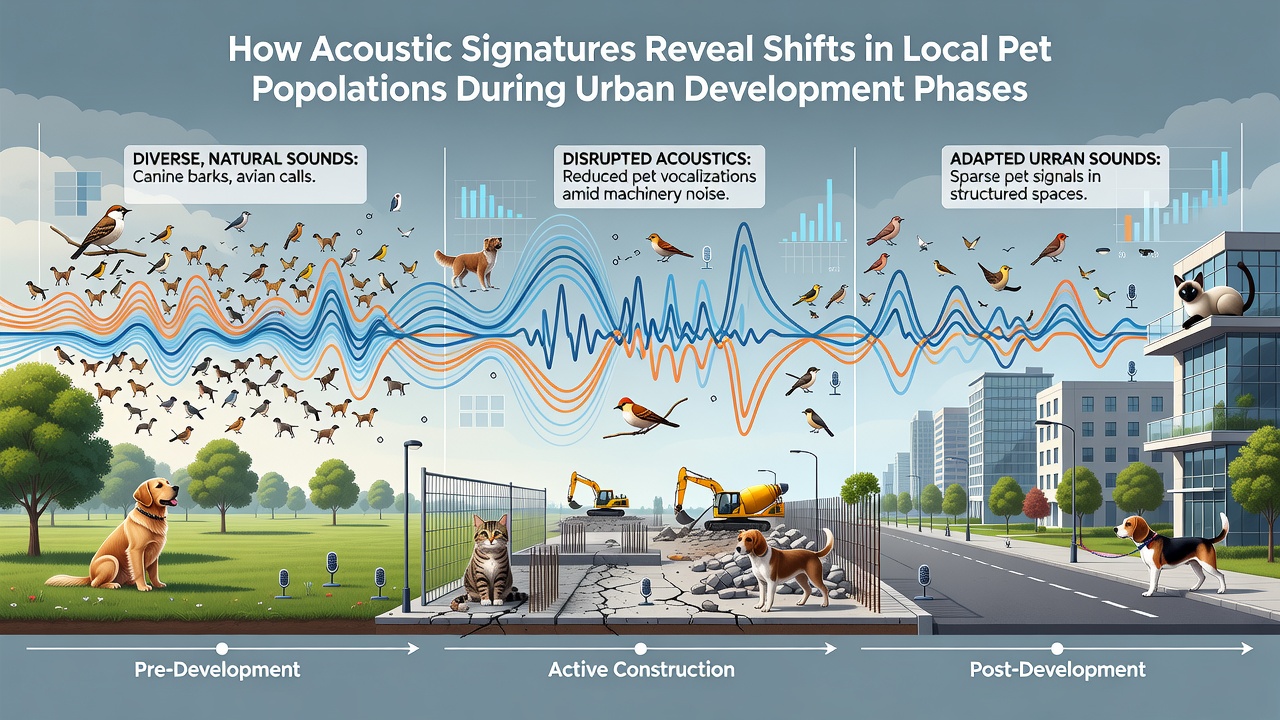
Researchers note that certain breeds and species exhibit distinct responses. Larger dogs maintain higher vocalization rates even near noise sources, whereas smaller breeds and cats show stronger avoidance, shifting territories outward by several blocks. Multi-year datasets from Canadian metropolitan projects reveal that areas with new high-density housing experience sustained elevation in cat vocalizations, likely reflecting increased indoor-outdoor movement in denser living situations.
Integration with Broader Urban Ecology Monitoring
Municipal planners now incorporate acoustic pet population data into environmental impact assessments alongside metrics for birds, insects, and native mammals. The European Environment Agency has referenced similar sound-based approaches in guidelines for assessing biodiversity impacts of infrastructure projects, highlighting how companion animal distributions reflect human occupancy changes. Cross-referencing acoustic results with satellite imagery of green space loss helps isolate development effects from seasonal or weather-related variations.
One long-term project in a North American city tracked three separate redevelopment zones and documented that pet acoustic activity stabilized only after completion of noise barriers and new park installations. Recovery timelines averaged 14 months in zones with retained tree cover, compared with 22 months in fully cleared blocks.
Data Processing and Validation Techniques
Advanced signal processing distinguishes overlapping calls in dense neighborhoods by using directional microphones and temporal pattern analysis. Validation teams conduct periodic ground-truthing walks to match recorded events with observed animals, refining algorithms iteratively. Publicly available datasets from these efforts allow independent researchers to test new detection models without repeating fieldwork.
September 2026 marked the release of an updated global urban sound library that includes standardized pet vocalization tags, enabling comparative studies across continents. Analysts using this resource have identified consistent thresholds where construction noise exceeds 70 decibels and triggers measurable pet redistribution.
Conclusion
Acoustic signature analysis provides a scalable, non-invasive method for documenting how urban development alters local pet populations through measurable changes in vocalization frequency, timing, and location. Continued refinement of recording networks and analytical tools supports more precise tracking, offering planners objective indicators of ecosystem responses that extend beyond traditional census methods.